
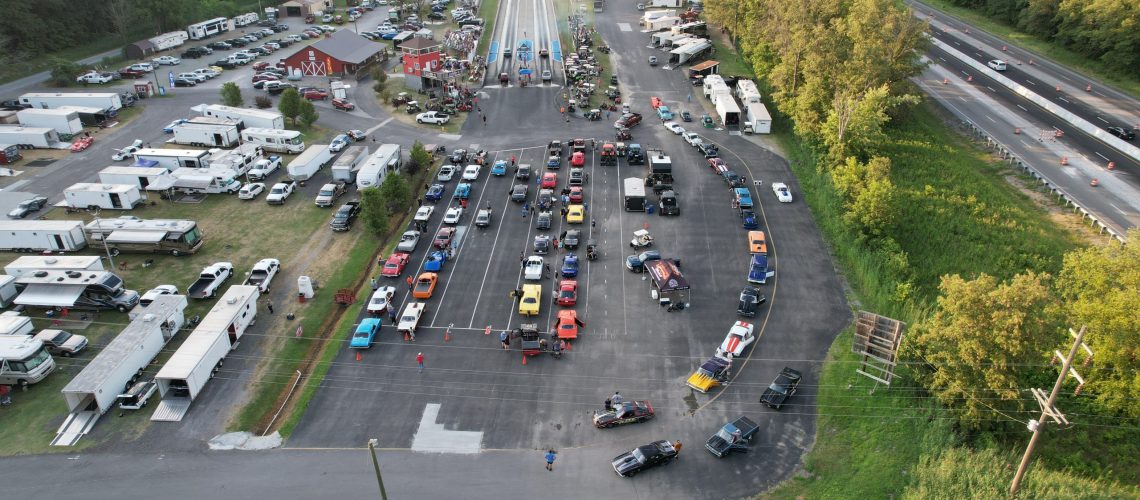
Fourteen years ago, my wife Jessica and I approached our local track owner Scott Bailey and pitched him an idea: we wanted to partner with him to put on a bracket race. Our vision: big race feel in a small track atmosphere. In the years since, our local track has undergone a major facelift. Ownership has changed hands. Yet the Moser Engineering Summer Door Car Shootout has become an annual staple for racers in the region. I’d even go so far as to say that it’s developed a bit of a cult following among both racers and fans, which is something that we’re extremely proud of: our little race delivers a fun and unique atmosphere that racers and fans value.
While I won’t claim that promoting and directing one event each season qualifies me to speak on behalf of track operators, I will say that standing on the other side of the pay window provides perspective that has proven valuable to me as a racer. In fact, I’d go so far as to say that every racer should, at some point, go through the experience of promoting and directing an event on some level. Why? Because it provides perspective on so many of the intricacies of competition and entertainment that, as a racer, it’s easy to take for granted.
We can witness the hard work and effort put forth by the ownership, management, and personnel of our local racing facility (or any facility for that matter) and yet, until we walk a mile in their shoes, it’s difficult to comprehend the variety of challenges that come with running an event, or the speed at which these challenges present themselves. I’ve heard Bill Bader, Jr. talk about “serving multiple masters” in regards to running his famed facility. As a track owner/operator he (like any other owner/operator) is tasked with creating and maintaining a positive experience for racers (on every level), spectators, sponsors, and employees. Doing so requires preparation, planning, organization, communication, and the ability to properly prioritize under intense pressure. It also inevitably means making one difficult decision after another, quickly, with the understanding that no single decision is going to serve each of those masters. This is all done with the innate understanding that circumstances beyond control can render all of that work useless (most often, these circumstances are weather-related… but every track operator has a story about something random going haywire to thwart a well-planned and potentially profitable event).
I’m not saying that everyone in this position does the job at the level of a Bill Bader, Jr., he’s a hall-of-famer. I think it’s possible to recognize that some people are better at this job than others, while acknowledging that it’s a very difficult job for all. Coming back to my own example: we put on one single event each season. We spend months preparing, securing dozens of marketing partners to invest in the event, hiring and leading an all-star team of multiple people, and hosting hundreds of racers and thousands of fans: it’s an undertaking! By the time the event comes, I’ve personally invested hundreds of hours into its success. By the time it’s over, I need at least a couple of days to recover, both physically and mentally. I have no desire to do that twice a year; much less weekly! And keep in mind as I say that, I get to go home on Sunday night following our event and collapse into hibernation. Meanwhile, our track crew is non-stop: scraping the race track, cleaning and mowing the grounds, repairing whatever needs attention, preparing for and promoting whatever event is on tap the following week.
The staff at your local track not only has a grueling job, but all too often a thankless one. The best compliment a track manager can get is that we (as racers or spectators) don’t realize that they’re there or what they’re doing. Typically, that means the event has run so seamlessly that they operate in the background, orchestrating the action like the conductor of a symphony. In short, when things go smoothly, we tend to take this pivotal position (and every track employee for that matter) for granted. When there’s a hitch, however, we’re all too often the first to point it out: so track officials tend to draw the ire of racers and spectators when things aren’t going perfectly, while they’re rarely recognized when the event is skipping along without a hiccup.
There’s one thing that I’ve learned from my time behind the scenes that I try to keep in mind as a racer, Jr. Dragster crew chief, and motorsports enthusiast. I’d like to use this platform to stress that point: there is really only one justification for successful track owners, managers, and employees to accept and retain their positions. The reason these track officials pour so much of their lives into these pursuits is the same reason that we, as racers and enthusiasts pour so much of our lives into the sport: because they have a passion for it. That’s the only reasonable justification.
I think we can all understand that race tracks are in business: the goal, like that of any business, is to support their employees and the families of those employees, and ultimately to turn a profit. We can pinpoint some facilities that achieve that goal on a regular basis. We can also bring to mind several that struggle, and far too many that have failed and ultimately had to close the gates. From my experience, I will say this: regardless of how profitable (or not) a facility is, the work rarely (if ever) justifies the pay. I guarantee you that if these individuals took the time, effort, and energy put forth into putting on a race, and poured it into a different pursuit, that other pursuit would be more profitable the vast majority of the time. And yet, they choose to do this for the same reason we do: they love the sport. That doesn’t mean they’re infallible, but more often than not it does mean that they’re trying. Our sport runs on passion – in every corner of the racing industry. And more often than not, that passion and effort on the part of track officials is worthy of our support as racers; whether that support is in the form of business, the occasional “attaboy,” or simply the grace to accept that every single decision cannot fall in the favor of every single racer at all times. Support your favorite race track(s). Support them with your wallet. Support them with your recommendation. Support them by providing constructive criticism. Support them, at times, by turning the other cheek when reasonable decisions are made that you may not completely agree with.
I’m sorry if this column has veered a path between preachy and encouraging. I feel like the message has fallen somewhere between, “Appreciate your race tracks, or you’ll miss them when they’re gone,” and “Today is give a track employee a hug day” (credit to our Summer Door Car Race announcer Willie Burnett on that one). Neither is really my intention. I write on this topic because my limited experience in race promotion and direction has provided me with a different perspective on and appreciation for the complexities, demands, and to be quite frank, the difficulty that these officials face. That experience has enforced in me, as a racer, a sense of respect for anyone who fill these roles, and a genuine appreciation for those who do it exceptionally well. Race track owners, operators, officials, and employees; here is a tip of the cap to you.
